

A Paid Claim Can Still Reveal a Pricing Problem
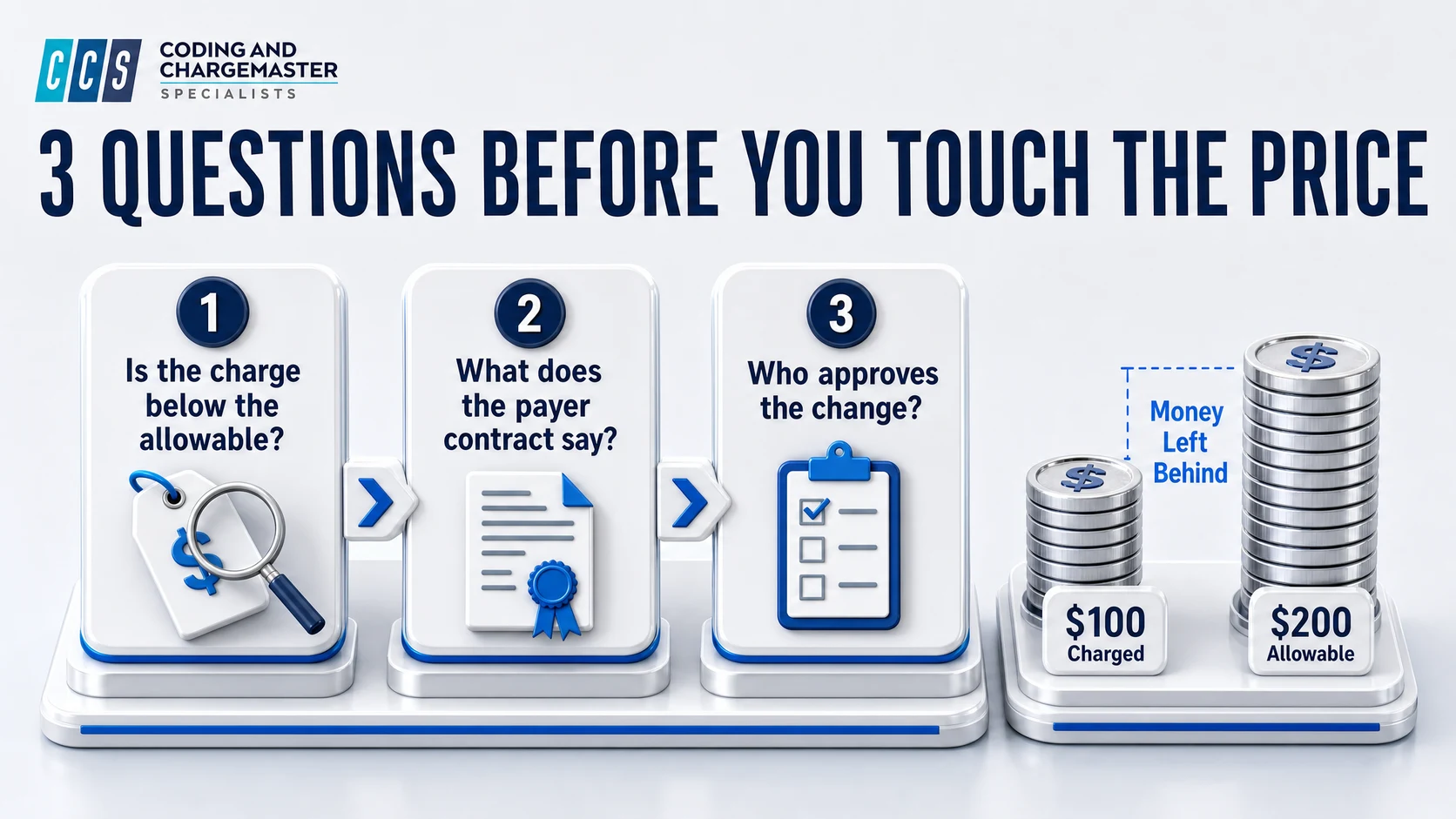
When a hospital charge falls below a Medicare allowable or another relevant reimbursement benchmark, the claim may still process normally. However, that does not mean the price is appropriate. Under some contract terms, payment may be limited to the lesser of the billed charge or the payer’s allowed amount. A low charge can therefore create missed reimbursement without producing a denial.
The comparison is a screening signal, not an instruction to raise every price. Hospital leaders still need to understand the affected service, payer terms, cost and market context, compliance requirements, and the organization’s pricing policy.
Three questions help turn the signal into a controlled review and solution.
1. Which Charge Lines Are Exposed?
Begin with data, not anecdotes. Compare current gross charges with relevant Medicare fee schedules and other approved benchmarks. Identify lines where the charge is below the fee schedule, then group results by department, service type, volume, and dollar difference.
Confirm that the comparison uses the correct code, unit, status, setting, and effective date. A false match can make a line appear exposed when the underlying services are not comparable.
Prioritize high-volume items and material differences but also look for patterns. A cluster within one department may indicate an outdated pricing method, missed annual update, inconsistent markup, or unclear ownership.
2. Does the Contract Pay the Lesser of the Charge or the Allowable?
A benchmark gap becomes a reimbursement concern only in the context of payment terms. Review whether the payer reimburses a fee schedule, case rate, percent of charge, or the lesser of the billed charge and an allowed amount.
Do not assume that Medicare’s methodology determines every payer’s payment. Use Medicare allowable amounts as one analytical reference, then validate the contracts and payer rules that apply to the hospital’s actual business.
For exposed lines, estimate impact using recent volume and payer mix. Separate confirmed opportunity from lines that require contracting, compliance, clinical, or finance review. This prevents a broad pricing conclusion from being drawn from an incomplete comparison.
3. What Pricing Input and Governance Decision Supports the Current Charge?
Every material price should be traceable to an approved method. Ask when the line was last reviewed, which input was used, who approved the decision, and how updates are documented. Inputs may include cost, market comparisons, reimbursement benchmarks, strategic policy, and consistency across related services.
If no owner can explain the current amount, the larger issue may be governance rather than a single price. Assign responsibility for validating the line, approving any change, updating the chargemaster, testing downstream systems, and retaining the decision record.
Move From Screening to Controlled Action
Use a short implementation sequence:
- Validate codes, units, settings, and effective dates.
- Confirm relevant payer terms and estimate materiality.
- Review cost, market, compliance, and organizational pricing inputs.
- Obtain documented approval for any change.
- Update and test the chargemaster and connected systems.
- Monitor reimbursement after implementation.
A pricing review should not be an automatic markup exercise. The objective is to identify lines that may be suppressing appropriate reimbursement, understand why and make a defensible decision through the hospital’s established governance process. The same discipline that governs implementing chargemaster review findings applies to pricing changes: every update needs an owner, an approval, and a validation step.
Pricing Belongs Inside Chargemaster Maintenance
Quarterly code updates, new services, payer changes, and aging inputs can all separate current charges from relevant benchmarks. That separation is rarely the result of a deliberate decision.
A repeatable review rhythm helps hospitals find that drift before it becomes a recurring revenue issue.
Learn why a stale chargemaster becomes a revenue-integrity problem, review CCS chargemaster review services, or contact CCS to discuss pricing analysis and maintenance support.