

The Report Is the Start of the Work
A chargemaster review can identify compliance issues, revenue capture and cash flow opportunities as well as outdated codes, pricing concerns, missing charges, and workflow gaps. Those findings create value only when the hospital assigns ownership, validates each correction, prepares affected departments, and confirms that approved changes reached production.
The central implementation mistake is treating delivery of the report as project completion. Without a controlled follow-through process, urgent findings compete with daily work, ownership becomes unclear, and corrective action stalls.
Prioritize Compliance Before Revenue
CCS structures its chargemaster review deliverables to help hospitals move from findings to implementation. Shannon Uhrmacher, CRCR, CPC, CPB, Director of Chargemaster Services at CCS, describes how the review materials culminate in a prioritized Facility Action Plan:
"We provide a line-by-line review, a summary of the interviews and CDM findings, and a Facility Action Plan that puts the recommendations in order, starting with compliance issues and moving into revenue."
— Shannon Uhrmacher, CRCR, CPC, CPB, Director of Chargemaster Services at CCS
That order should govern implementation. Compliance findings come first, followed by revenue and operational opportunities. Within each group, leaders can sequence work by risk, dependency, and effort.
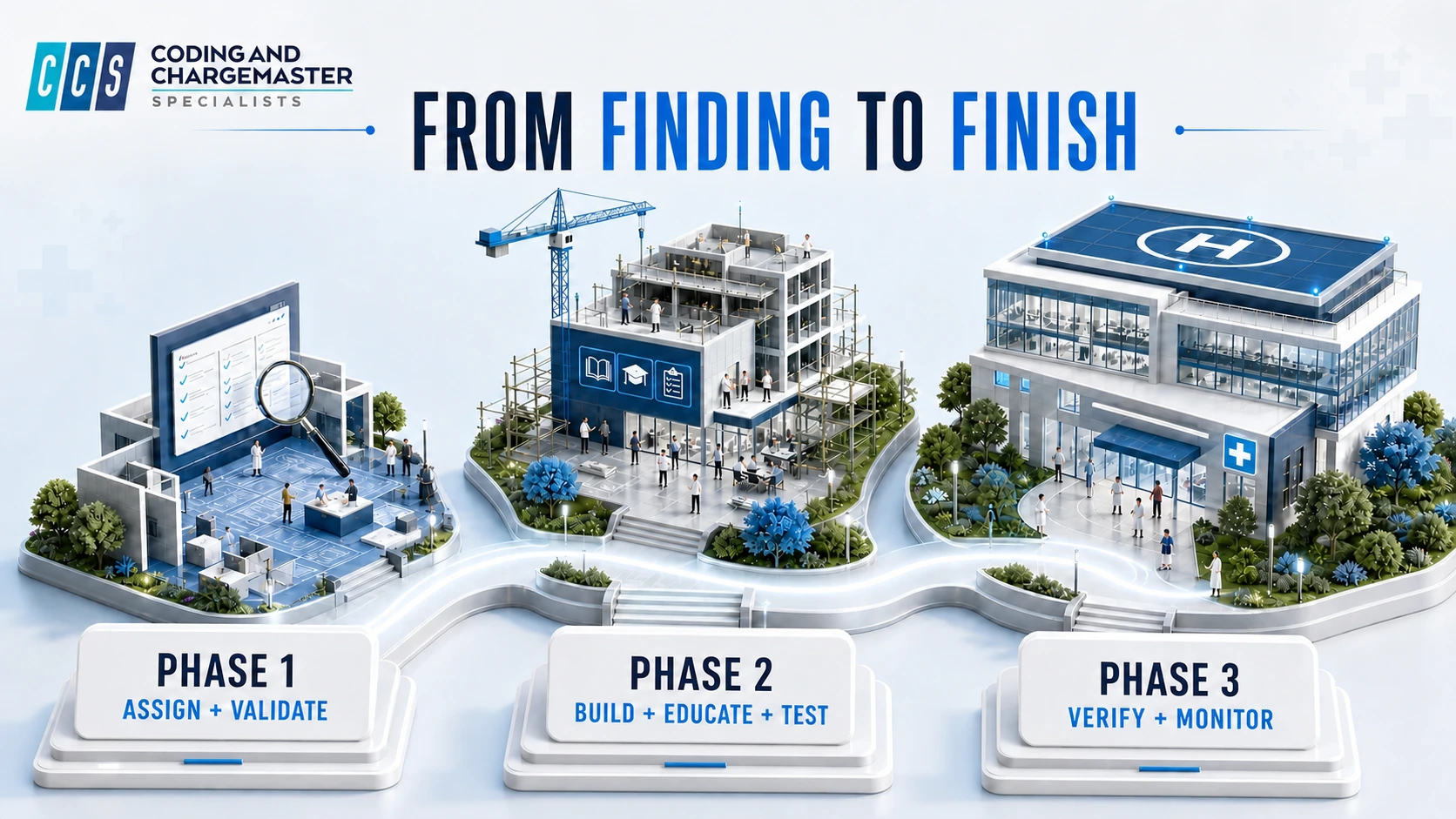
Phase 1: Assign and Validate
Create one implementation register for every finding in the report. Record the risk category, required action, accountable owner, affected departments, dependencies, target date, and evidence needed for closure.
In this phase:
- Confirm the factual basis and intended correction for each priority finding.
- Assign one accountable owner, even when several departments must participate.
- Identify required compliance, clinical, payer, finance, or information-technology validation.
- Separate direct corrections from work that requires policy, workflow, or system redesign.
Phase 2: Build, Educate, and Test
Move approved changes through the hospital's change-control process. Update charge logic, code assignments, descriptions, pricing, policies, or department workflows as required.
Keep education specific to each role. Department leaders need the reason for the change, frontline staff need the revised action, and revenue-cycle teams need to understand downstream effects and escalation points.
Before release, test representative scenarios. Confirm that interfaces, edits, and claims behave as intended.
Phase 3: Verify Completion and Results
Do not close a finding based on status alone. Require evidence such as a production screenshot, approved build record, updated policy, completed education log, sample claim, corrected CDM line, or validation report.
Then monitor the issue the change was meant to correct. Relevant indicators may include denials, edit volume, charge capture, payment variance, and department questions. Verification should show that the original problem was addressed without introducing a new one.
Keep the Action Plan Active
Review the register on a fixed cadence until every item is complete, deferred with documented reasoning, or formally accepted as a risk. Escalate overdue compliance findings and any item blocked by unclear ownership.
Hospitals with limited internal capacity may need ongoing chargemaster review and maintenance support to keep implementation moving and prevent quarterly and annual updates from accumulating.
A Review Only Creates Value When Findings Become Action
A strong review is measured by more than the quality of its findings. The hospital must be able to translate those findings into accurate, controlled operational changes. A three-phase sequence gives leaders a practical structure for maintaining momentum after the report is delivered.
Read why a stale chargemaster becomes a revenue-integrity problem, or contact CCS to discuss a Comprehensive Chargemaster review with a Facility Action Plan or ongoing implementation support.