

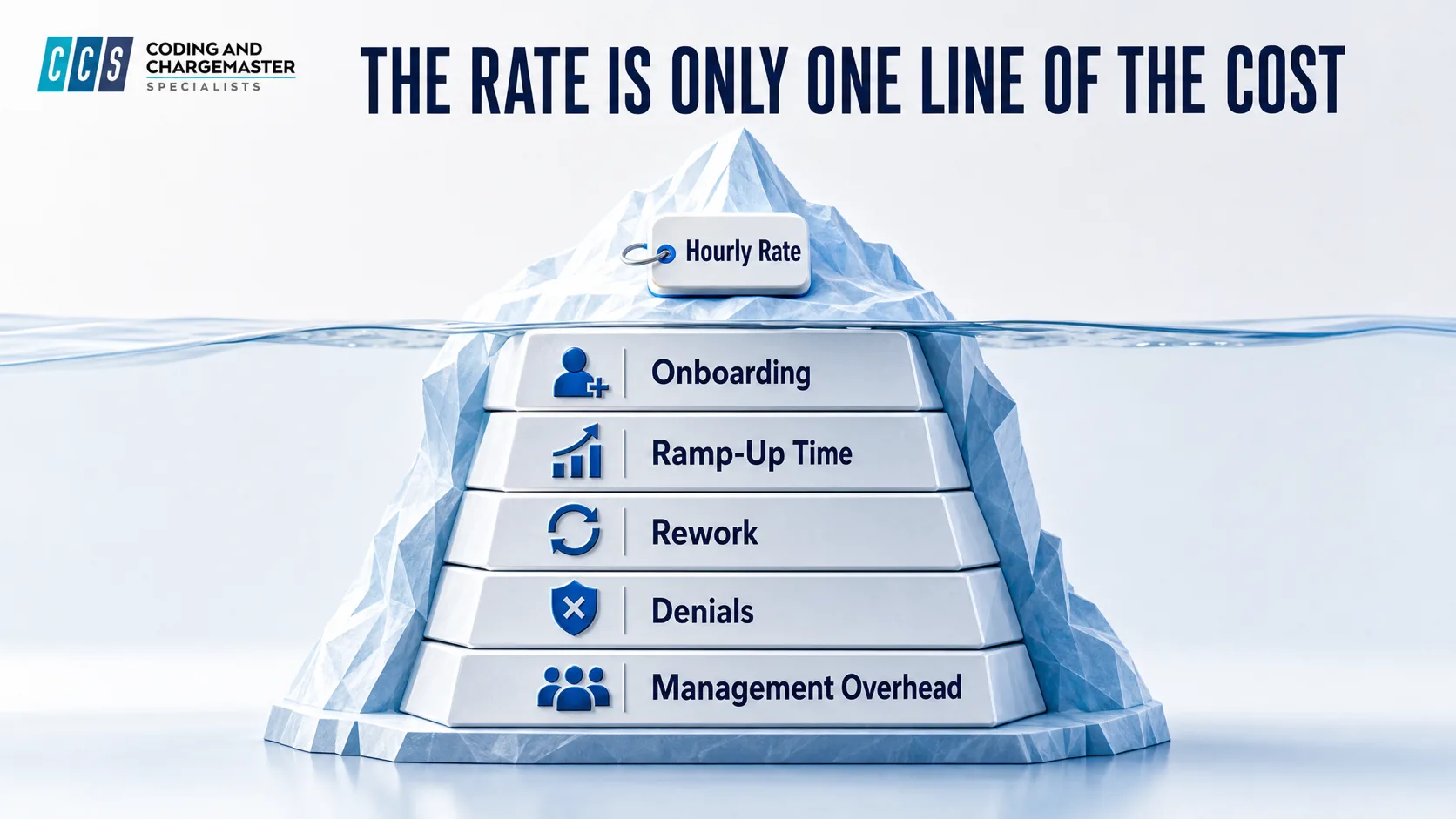
The Hourly Rate Is Only One Line of the Cost
A low hourly coding rate is easy to compare. The harder costs appear after work begins: Multiple onboarding, access setup, productivity disruption, quality review, rework, denials, and the time hospital staff spend managing transitions. When those costs are ignored, the lowest rate can produce the highest total operating burden.
The right question is not simply, "What does a coding hour cost?" It is, "What will it cost the hospital to receive accurate, high productivity, timely, compliant coding without repeatedly starting and training new coders?"
A Turnover Scenario Shows the Hidden Work
Consider a hospital that selects a vendor primarily on price. The assigned coder learns the facility’s systems, specialties, local rules, and escalation process. A few months later, that coder leaves the account. The hospital then repeats access provisioning, workflow orientation, productivity ramp-up, and closer quality review for the replacement.
Even if the vendor absorbs some transition activity, there will still be a period of low productivity, hospital employees still answer questions, validate access, explain client-specific instructions, monitor early work, and resolve disruption. Repeated turnover converts a nominal vendor savings into internal labor and delayed throughput. Also, the lower productivity increases the fee
Sharie Broecker, RHIT, CCS, Director of Coding and Auditing Services at CCS, sees that ramp time even in transitions that are planned and going well:
"You do not want to call off your contract people right away when you have a new hire, because they are still getting used to the system. Depending on their background, it might take them a little while to get up to speed. Before you release your contract support, you want to make sure you are ready to take it over."
— Sharie Broecker, RHIT, CCS, Director of Coding and Auditing Services at CCS
If a deliberate, well-managed handoff requires that much care, an unplanned vendor departure extracts the same ramp-up cost without the planning — and repeats it every time the assigned coder changes.
Five Costs to Include in the Comparison
1. Transition and onboarding
Measure the time required from hospital IT, HIM, coding leadership, compliance, and revenue-cycle staff. Include credential verification, system access, testing, workflow documentation, and orientation.
2. Productivity disruption
A new coder may need time to learn the facility’s record structure, case mix, charge-entry responsibilities, and communication pathways. Track whether accounts age or internal staff absorb work during that ramp.
3. Quality review and rework
Low-cost work is not inexpensive if the hospital must add extensive auditing, correct repeated errors, or return claims for clarification. Evaluate both the vendor’s quality controls and the hospital effort required to verify them. A capable partner should be able to show what its quality program measures beyond productivity.
Sharie Broecker is direct about which standard has to come first:
"Accuracy has to be the highest priority. We definitely look at productivity, but the accuracy has to be there. We are here to help the client, not put them in further trouble — we do not want to increase denials, hold things up, or be the reason they are missing revenue. Nobody wants to hire somebody who is going to do it wrong."
— Sharie Broecker, RHIT, CCS, Director of Coding and Auditing Services at CCS
4. Denials and delayed billing
Coding errors, incomplete documentation follow-up, or missed client instructions can create edits, denials, rebilling, and compliance issues and delayed cash flow. These effects may appear in another department long after the coding invoice is paid.
5. Management burden
Count the time spent coordinating schedules, escalating issues, replacing coders, reconciling reports, and communicating expectations. A relationship that requires continuous intervention has a higher total cost than its rate card suggests.
Compare the Operating Model, Not Just the Price
Ask each coding partner to explain coder retention, specialty matching, client onboarding, transition coverage, quality review, escalation, and day-to-day accountability. Request examples that show how the vendor preserves continuity when staffing changes.
A useful comparison should include:
- Hourly or per-record price.
- Expected onboarding and ramp time.
- Accuracy standards and audit cadence.
- Coder retention and replacement process.
- Hospital oversight hours.
- Rework, denial, and delayed-billing indicators.
- The party responsible for resolving performance issues.
Build a Simple Total-Cost View
Start with the contracted cost, then add estimated hospital labor for onboarding and management, the cost of expanded quality review, and measurable rework or delay. Review the result over a meaningful period rather than a single invoice cycle.
Not every operational effect can be reduced to a perfect dollar amount. The exercise still reveals where risk is being transferred back to the hospital. It also makes vendor discussions more specific by connecting price to continuity, accuracy, and internal workload.
Reliable Capacity Should Reduce Hospital Burden
Outside coding support should help a hospital protect compliance, revenue, and cash flow while maintaining control of its workflow. A lower rate is valuable only when the operating model also delivers qualified capacity, consistent quality, and continuity.
Review seven questions every hospital CFO should ask a coding company, read why coding is not a commodity, or contact CCS to discuss flexible hospital coding support.