

Productivity Does Not Tell Leaders Whether the Code Is Right
Charts per hour and turnaround time matter because coding delays affect billing and cash flow. They do not show whether the assigned codes are accurate, whether documentation supports them, whether facility-specific processes were followed, or whether the same issue is recurring across coders.
A strong coding quality program treats productivity as one operational measure within a broader system. Compliance and accuracy come first. Productivity is interpreted in the context of specialty, case complexity, workflow, and the level of review a coder currently requires.
Start With Accuracy and Error Patterns
An overall accuracy percentage is useful only when leaders can see what sits underneath it. Track the type, severity, and recurrence of errors. Separate code-selection issues from documentation, sequencing, modifier, charge-entry, and facility-workflow issues when applicable.
Sharie Broecker, RHIT, CCS, Director of Coding and Auditing Services at CCS, describes how CCS pairs its stated accuracy rate with monthly QA and additional review during onboarding:
"We have a 98 percent accuracy rate. We perform monthly QA. If it is a new project, we may begin with 100 percent QA to make sure the coder is comfortable with everything. We also have a format for onboarding new coders and new clients."
— Sharie Broecker, RHIT, CCS, Director of Coding and Auditing Services at CCS
Sharie's description is specific: monthly QA is the ongoing cadence, while 100 percent review is an onboarding approach CCS may use for a new project or a coder who is new to the organization.
Six Signals to Measure Together
- Coding accuracy: Evaluate whether the final assignment is supported, complete, and compliant.
- Error severity: Distinguish minor corrections from errors with compliance, payment, or denial implications.
- Recurrence: Identify whether the same issue returns after education or corrective action.
- Specialty and case fit: Assess coders against the specialties and case types they are trained and assigned to handle.
- Facility-workflow adherence: Confirm that the coder follows client-specific systems, charge-entry responsibilities, and escalation paths.
- Education closure: Track whether identified issues produced education and whether later review showed improvement.
Use Productivity as a Diagnostic, Not a Verdict
A productivity change may signal a learning curve, a difficult case mix, a system problem, unclear client instructions for contract coders, or a quality concern. Leaders should investigate the cause before concluding that an individual coder is the problem.
The reverse is also true. High output does not offset a recurring accuracy issue. A balanced review asks whether work is timely, accurate, defensible, and consistent with the hospital's workflow.
Connect Every Measure to an Action
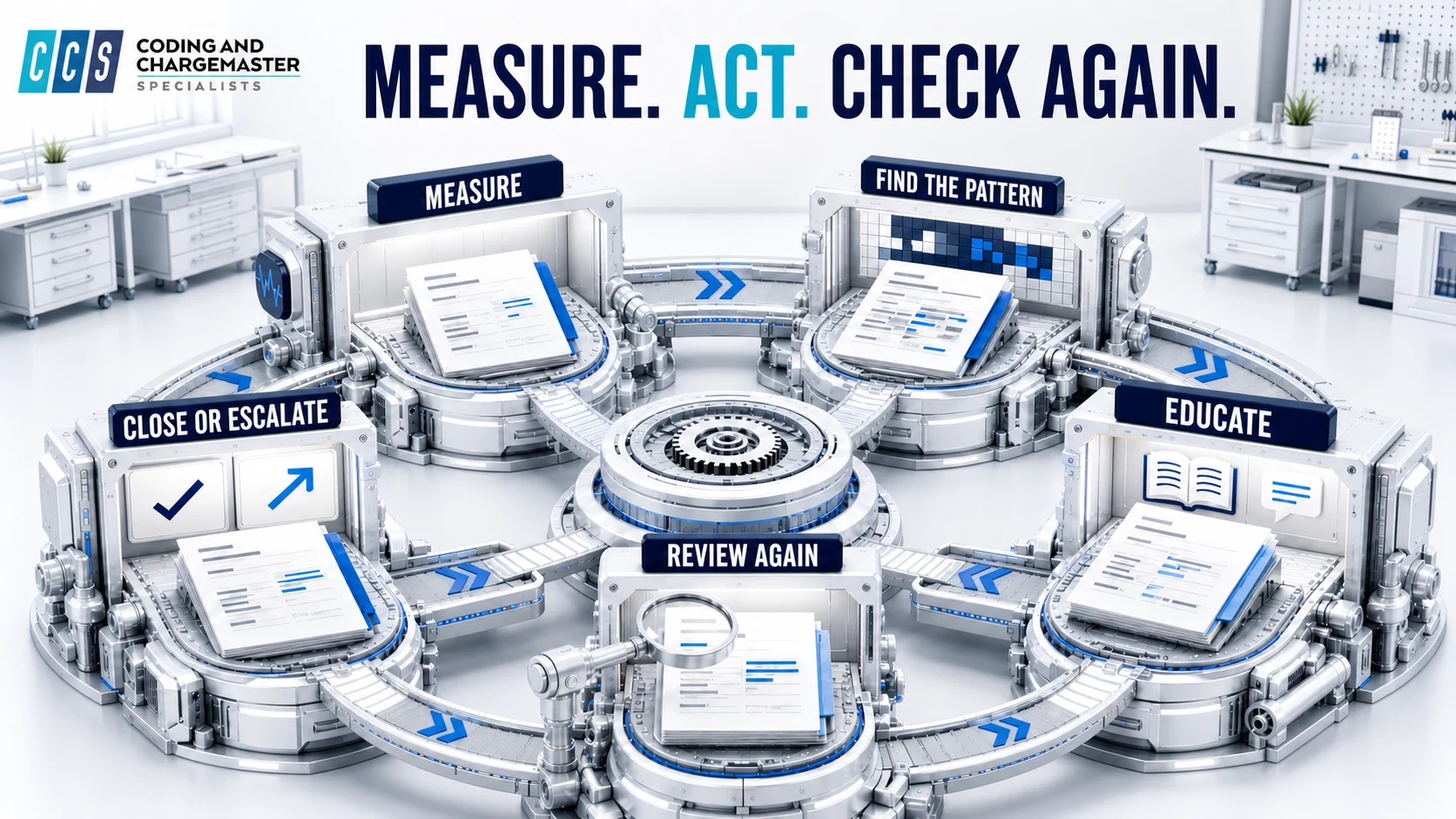
Metrics are useful when they trigger a defined response. A repeated code-selection issue may require targeted coder education. A documentation pattern may require CDI or physician outreach. A facility-workflow error may point to incomplete onboarding. A system-wide denial trend may justify a focused coding audit.
Create thresholds for additional review, coaching, retraining, specialty reassignment, or escalation. Document the intervention and test whether it worked.
Report Quality in a Way Leaders Can Use
A monthly quality review should show overall trends, meaningful error categories, high-risk findings, completed education, unresolved process issues, and the next corrective action. Include productivity, but do not allow it to dominate the discussion.
For outsourced or supplemental coding, hospital leaders should also understand who performs the quality review, how often it occurs, how findings are communicated, and what happens when performance falls below the agreed standard.
A Quality Program Should Reduce Uncertainty
The purpose of measurement is not to produce more dashboards. It is to show whether the hospital can trust the coding work, where risk is concentrated, and whether education and corrective action are improving performance.
CCS supports hospital coding teams with specialty-matched U.S.-based coders, structured quality review, focused education, and coding audits designed around the facility's actual workflow and priorities. Learn how to turn coding audit findings into an education plan, or contact CCS to discuss a focused quality review.