

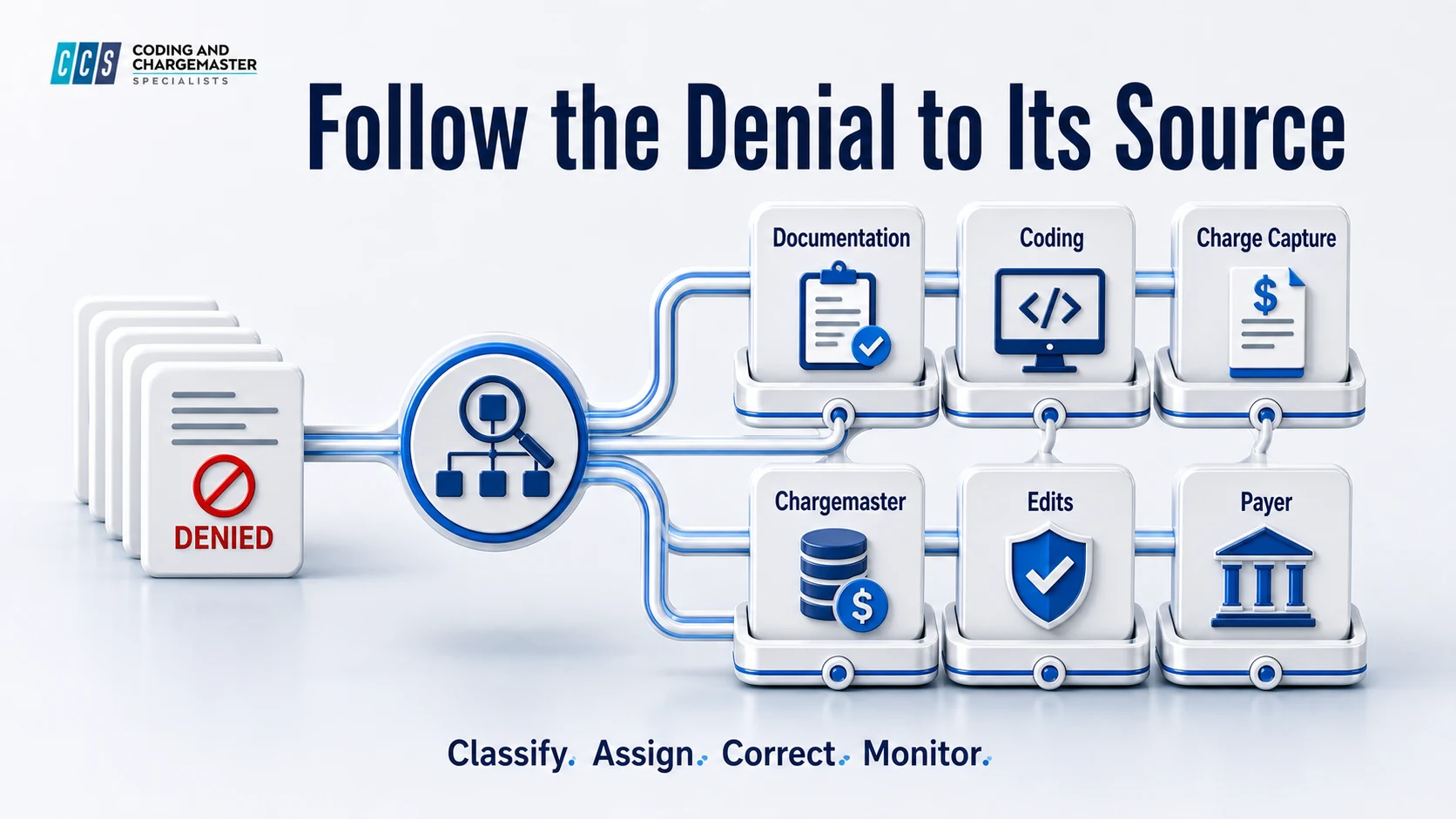
A Denial Code Is Not Always the Root Cause
A recurring denial may first appear to be a billing problem. The actual cause can sit earlier in the revenue cycle: incomplete documentation, an unsupported coding decision, a missed charge, an outdated chargemaster line, a system edit, or a payer-policy change. If the hospital routes every denial to the same team, it may correct individual claims without correcting the process that keeps producing them.
The goal of denial analysis is to move from the payer’s stated reason to the operational cause the hospital can control.
Sharie Broecker, RHIT, CCS, Director of Coding and Auditing Services at CCS, describes how the signal usually surfaces:
"Sometimes they can see it in their denials from the payers, or in claims that are not getting paid or billed timely — that is usually a flag. If they have a lot of accounts held up that they are not able to bill, it could be as simple as a physician not completing proper documentation, or one inpatient coder being out on leave."
— Sharie Broecker, RHIT, CCS, Director of Coding and Auditing Services at CCS
Start With a Pattern, Not a Single Claim
Group recent denials by payer, reason code, service line, department, procedure, provider, code, and dollar value. Add frequency and trend over time. This shows whether the issue is isolated, concentrated, or systemic.
Then review a representative sample of records from each meaningful pattern. The sample should follow the claim backward through documentation, coding, charge capture, the chargemaster, claim edits, and payer requirements.
Six Root-Cause Categories
1. Documentation
The record may lack specificity, medical necessity support, an order, a signature, or another required element. The corrective owner may be clinical leadership, CDI, medical staff education, or a query-process owner rather than coding alone.
2. Coding
The denial may involve code selection, sequencing, modifiers, bundling, or application of current guidance. As Sharie Broecker observes: "We keep our coders and auditors educated on the updates, because one little change can mean a denial or missed revenue." Determine whether the issue is an individual error, a repeated education need, or a broader policy interpretation that requires focused audit.
3. Charge capture
A documented service may never reach the claim, may be entered with the wrong quantity, or may be handled inconsistently across departments. Trace the workflow from service delivery through charge entry and reconciliation.
4. Chargemaster
An outdated code, revenue code, description, modifier rule, unit, or charge logic can create repeated denials across many accounts. Correcting one claim will not resolve the pattern if the source line remains unchanged.
5. Claim edit or system configuration
An interface, scrubber rule, claim edit, or system mapping may alter, omit, or reject otherwise valid information. Include IT and patient financial services when the record and coding are correct but the submitted claim is not.
6. Payer policy or contract
The payer may have changed medical policy, authorization rules, filing requirements, or coding edits. Validate the effective date and contract terms before changing an internal process to fit what may be a payer-specific issue.
Assign the Owner That Can Change the Process
Create a denial action register with the pattern, root cause, accountable owner, corrective action, target date, and validation measure. One accountable owner should coordinate each item even when several departments participate.
Examples include:
- Coding leadership for recurring modifier application.
- CDI or clinical leadership for documentation specificity.
- A department manager for missed charge capture.
- Revenue integrity for a chargemaster correction.
- IT for mapping or edit configuration.
- Contracting or payer relations for a policy dispute.
Test Whether the Correction Worked
Do not close the issue when education is delivered or a build ticket is completed. Monitor new claims and denials after the effective date. Confirm that the targeted denial rate falls without creating a different edit, compliance concern, or workflow burden.
Useful measures include recurrence, overturned-denial rate, prevented dollars, rework volume, days to resolution, and compliance findings. Use the measures to verify improvement, not to chase a single percentage without context.
Connect Denials to Coding and Chargemaster Governance
Recurring denials are operational feedback. They can reveal where documentation education, coding quality review, charge reconciliation, quarterly CDM maintenance, or payer-policy monitoring is not closing the loop.
A cross-functional review converts that feedback into prevention. CCS supports focused coding audits, chargemaster reviews, and implementation planning designed to identify the source of recurring revenue-cycle friction. Learn how to turn coding audit findings into an effective education plan, or contact CCS to discuss a targeted review.